
Tracking Manufacturing Investments in Germany for the Bertelsmann Foundation and the ifo Institute.
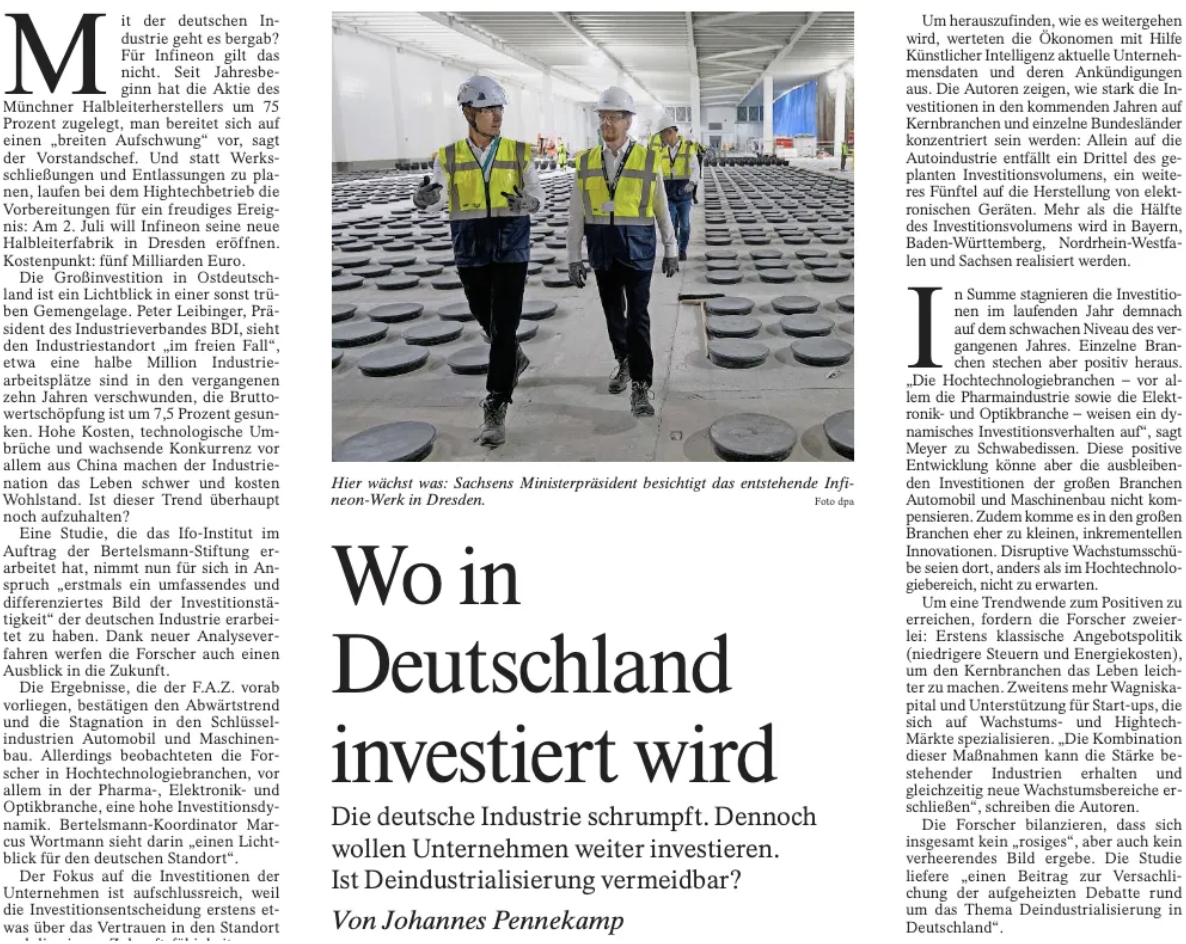
A recent feature in the Frankfurter Allgemeine Zeitung (F.A.Z.), one of Germany’s most preeminent newspapers, has highlighted the critical debate surrounding Germany’s industrial landscape and whether deindustrialisation can be actively avoided.
The feature refers to a new study conducted by the ifo Institute on behalf of the Bertelsmann Foundation, which claims, for the first time, to provide a comprehensive and nuanced picture of investment activity in German industry. At Glass.AI, we were pleased that our AI capability played a central role in generating the granular evidence that underpins this important research.
A New Approach to Tracking Corporate Investments
In response to this challenging topic of deindustrialisation, the Glass.AI capability was used to conduct deep research on the web to uncover detailed and complex patterns of investment across the German manufacturing base. Rather than relying solely on binary, lagging and traditional reporting metrics, the project leveraged our innovative data collection methods to monitor investments by manufacturing companies, both retrospectively and in real time.
To achieve this, our AI had to deep research thousands of unstructured sources across the open web to identify current and planned investment announcements. Some of the sources included:
The websites of German manufacturing companies
German and international media and news reports
Federal Government sources in Germany
Open source directories and registers of investment
The data was then processed and we extracted details pertinent to the research, including investment locations, values, timescales, delivery status and whether the German Government was an active funder of expansion or relocation.
Crucial to the success of this project was a close partnership with the ifo Institute, one of Germany’s largest and most influential economic think-tanks. Collectively, we developed a highly automated method for data capture, combining the power of AI with rigorous economic frameworks to validate the information. This was then used to analyse the findings and shape the report published by the Bertelsmann Foundation.
Illuminating and Impactful Results
This high-fidelity intelligence allowed economists to map a total of 7,113 investment projects by German manufacturing firms from 2023 to 2030. The underlying dataset and analysis also illuminated the shifting dynamics of the German economy, one which is of significant concern to policymakers, companies and politicians. This confirmed that:
Stagnation at the centre of Germany’s manufacturing sector, including its world-renowned automotive and mechanical engineering industries, is a real threat to the national economy, especially in the context of global competition.
Conversely, the analysis exposed a dynamic wave of high-tech investments in the pharmaceutical, electronics, and optics industries, suggesting a restructuring of domestic capability and the potential for Germany to be a frontier industry leader.
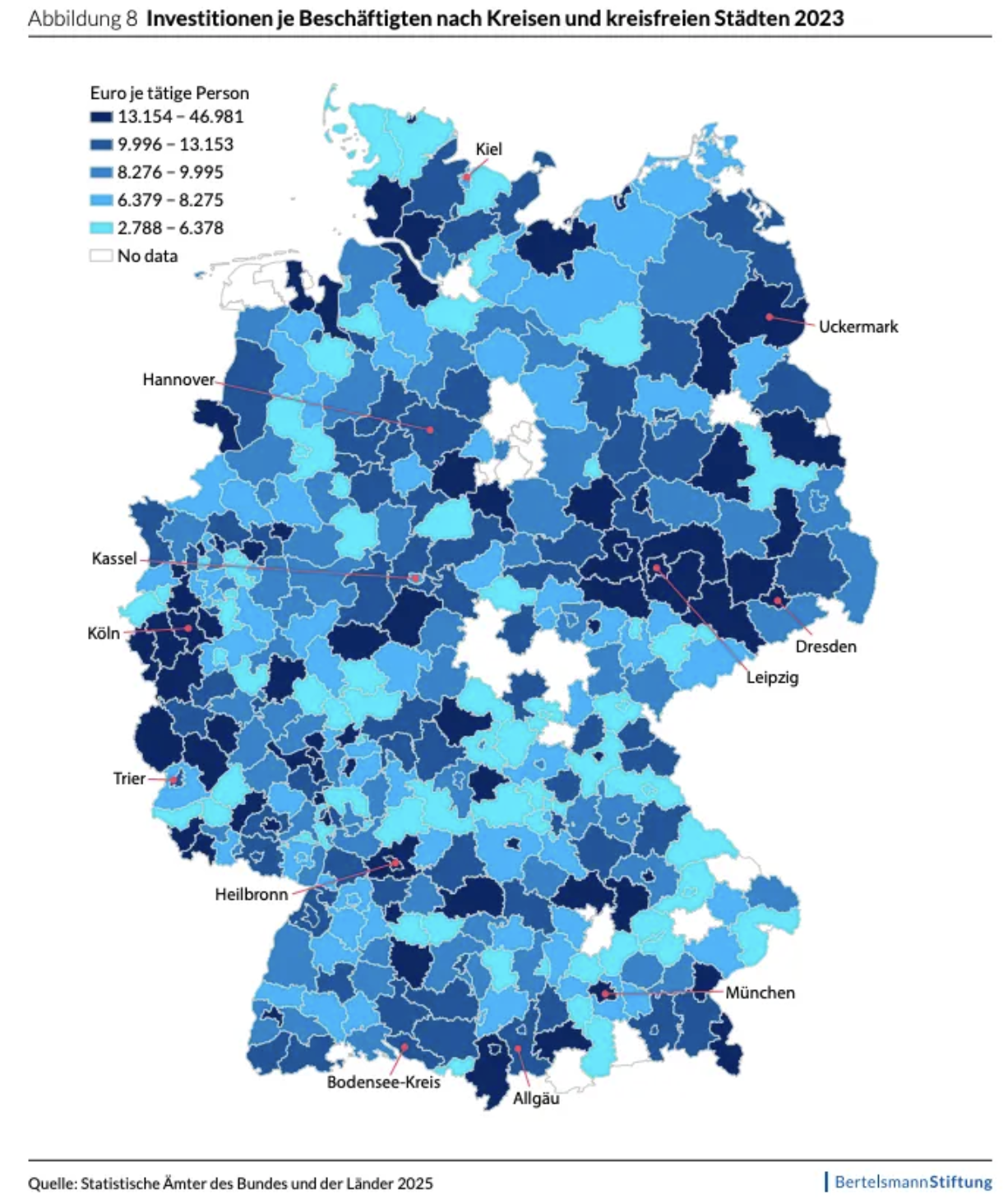
Source: Bertelsmann Foundation, ifo Institute
Beyond this, the report published by the Bertelsmann Foundation and the ifo Institute set out further findings, including investment trends, spatial distributions and investment types breakdowns. The nature of the research and wider media attention suggests this will be an important signal to investors and government policymakers.
Breaking New Ground in Investment Research
This project has represented a significant achievement and is a testament to the impact of combining robust academic-led research approaches with pioneering AI technology to delve deeper into company investment patterns. Furthermore, it has served as an example of how comprehensive investment data can be collected from unstructured sources, regularly and continuously, which could offer enormous opportunities to researchers and policymakers.