
The CMA Uses Glass.AI to Identify Growth Signals Across Millions of UK Firms.
Finding high-growth companies is harder than it looks.
Traditional approaches typically rely on measures such as revenue and employment growth. But revenue data is often unavailable, particularly for smaller private companies, while employment data can be incomplete or only become available with a significant delay.
A new study from the Competition and Markets Authority (CMA) explores a different approach: looking for growth signals in the public web.
The CMA’s new report, High-growth firms, examines the characteristics and growth trajectories of high-growth businesses and asks whether web-based data can complement traditional approaches to identifying fast-growing firms.
Looking beyond traditional growth indicators
Companies often signal that they are growing before it becomes visible in traditional sources like company databases.
These ‘signals’ may be:
Hiring new employees and advertising new roles
Launching new products or services
Entering new markets or expanding internationally
Raising investment or undertaking M&A
Announcing new customers, contracts or partnerships
Increasing innovation and R&D activity
These activities leave a digital footprint across company websites, news, social media and other public sources.
The challenge is finding these signals systematically across millions of businesses.
Glass.AI analysed millions of UK firms
For the study, the CMA commissioned Glass.AI to build a comprehensive dataset of all UK firms with growth signals.
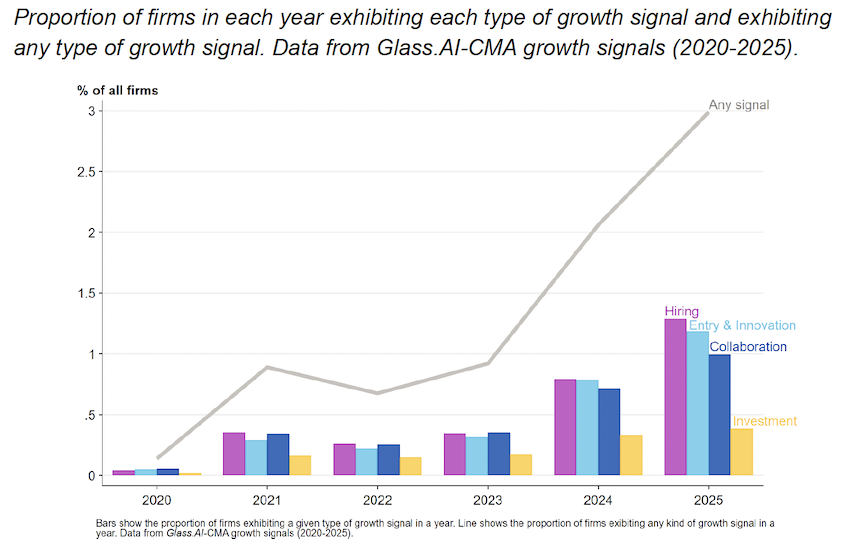
We applied our AI, which conducts deep research across the web, to research the activities of millions of UK firms with a web presence, identifying and classifying growth-related activity between 2020 and 2025. The dataset was then matched with Companies House records, allowing the CMA’s economists to compare web-based signals with conventional measures such as employment growth.
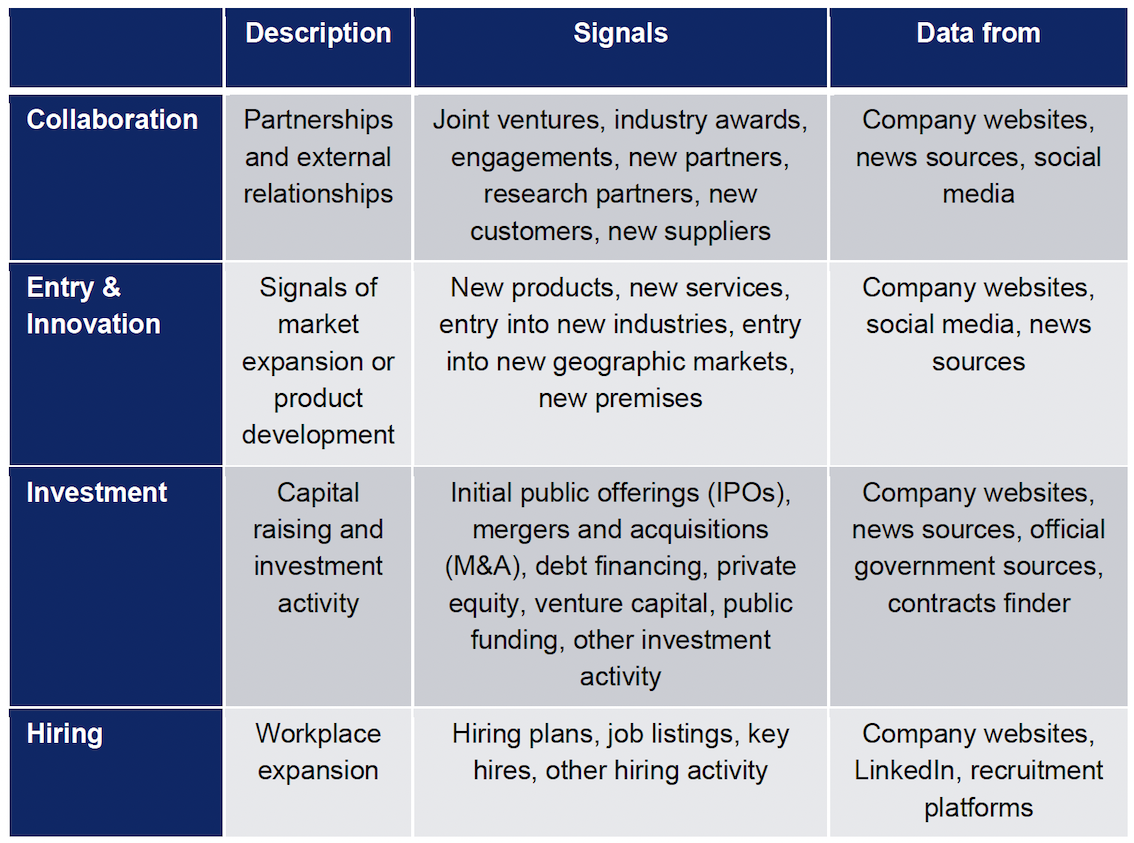
The research identified four broad categories of signals:
Hiring: evidence of recruitment and expansion of the workforce.
Entry and innovation: new products, services, markets, locations and innovation or R&D activity.
Collaboration: new customers, partnerships and other business relationships.
Investment: investment, funding, acquisitions and related activity.
This illustrates one of the advantages of Glass.AI’s approach: rather than relying on a predefined database of companies or a limited set of structured fields, our AI can read and interpret information published across the web to identify evidence of what companies are actually doing. Furthermore, the evidence can always be validated, showing the data provenance.
Growth signals are associated with faster growth
The CMA’s analysis found a strong relationship between web-based growth signals and subsequent employment growth.
Firms displaying growth signals grew their employment by around 20% per year on average, roughly twice the rate of firms without signals. This relationship was statistically significant and was observed across all four signal categories.
The relationship was particularly strong for firms displaying investment and hiring signals, which had average employment growth of around 24%.
The study also found that firms displaying a wider variety of signals tended to grow faster. Companies exhibiting three or four different types of growth signal had significantly higher average employment growth than those displaying only one or two.
Most importantly, the signals were more prevalent among firms already classified as high-growth. This suggests that information visible on the web can provide a useful complement to conventional measures of business growth.
A new source of evidence for economic research
The CMA’s research demonstrates the potential of web data to extend the evidence available to policymakers and researchers.
Official business datasets remain essential. But they can be limited by reporting requirements, coverage and time lags. Web data offers a different perspective: it captures what companies are announcing and doing in near real time.
This is particularly valuable when studying dynamic areas of the economy where conventional classifications and statistics can struggle to keep pace.
The CMA’s study builds on earlier research by the ONS Data Science Campus, which also used web data provided by Glass.AI to investigate the characteristics of high-growth companies.
At Glass.AI, we are continuing to develop this capability beyond one-off research projects. Our AI can now track growth and other company signals across millions of businesses globally, enabling organisations to monitor changes in companies, sectors and markets at scale.
Read the full CMA report, High-Growth Firms, to see the complete analysis and findings.
Glass.AI has built AI technology that reads and analyses the public web to deliver in-depth, evidence-based insights on millions of companies, sectors and themes.