
What is Transparent AI?

Glass.AI's Transparent AI delivers evidence-led research by discovering, validating and connecting evidence from the business web.
AI transparency is often concerned with making models more understandable, explaining how they work, why they produce particular outputs, or what influences their decisions.
Glass.AI takes a different approach to transparency: make the evidence behind the output visible, traceable and testable.
Traditional AI transparency asks: “Why did the model produce this answer?”
Glass.AI's Transparent AI asks: “What evidence supports this answer?”
It provides an evidence layer for AI and business research, where findings can be traced back to their sources, investigated and continually refined.
From AI that generates answers to AI built on evidence
Large language models can write, summarise and reason with remarkable fluency. But fluency is not the same as evidence. An LLM can generate a convincing answer without establishing where its claims came from, whether the underlying information is still accurate, or what evidence supports the conclusion. Even when sources are provided, the reasoning behind the output remains largely hidden within the model.
Transparent AI is designed around the evidence behind an answer.
Rather than asking a model to generate an answer from what it has learned, Glass.AI's research system discovers evidence from the business web, structures what it finds, connects related evidence and validates it against other sources.
Each data point can be traced back to its source. Connections between entities can be investigated through the evidence that supports them. Gaps, contradictions and uncertainty can be identified rather than hidden behind a confident answer.
The objective isn't simply to explain why an AI produced an output. It is to make the evidence on which the output is based visible, traceable and testable.
Transparent AI is therefore auditable by design: the path from research question to evidence to conclusion can be investigated rather than reconstructed after the fact.

From the web to evidence
The business web contains an enormous amount of information, but finding useful evidence is not simply a matter of searching harder.
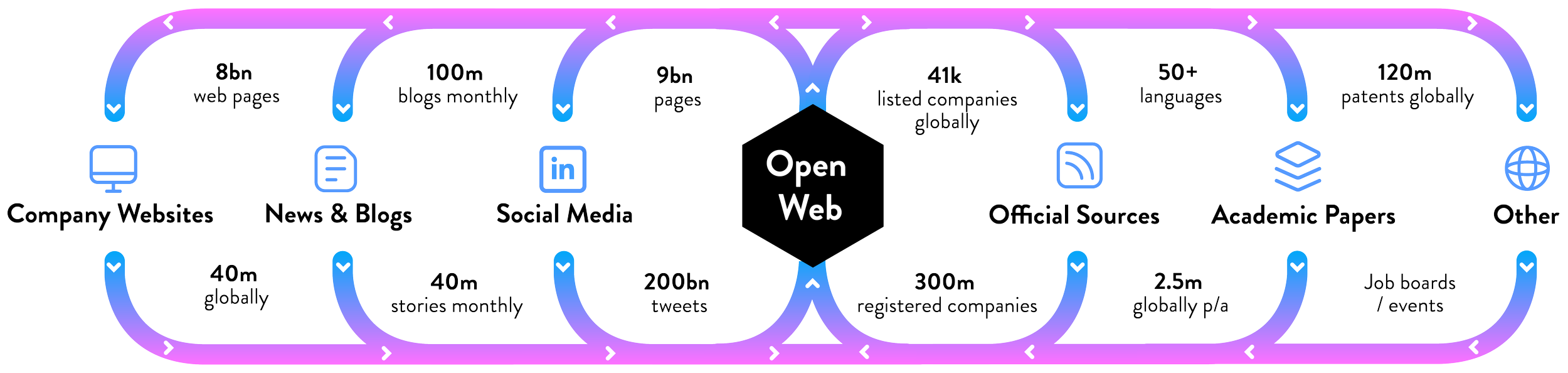
Relevant evidence can be distributed across company websites, news, regulatory filings, government registers, industry publications, social channels, research and other sources. It can also be incomplete, duplicated, contradictory or buried deep within websites.
Glass.AI is designed to work across this complexity through an iterative evidence lifecycle: discovering, structuring, connecting, validating and updating evidence to build a progressively stronger evidence base.
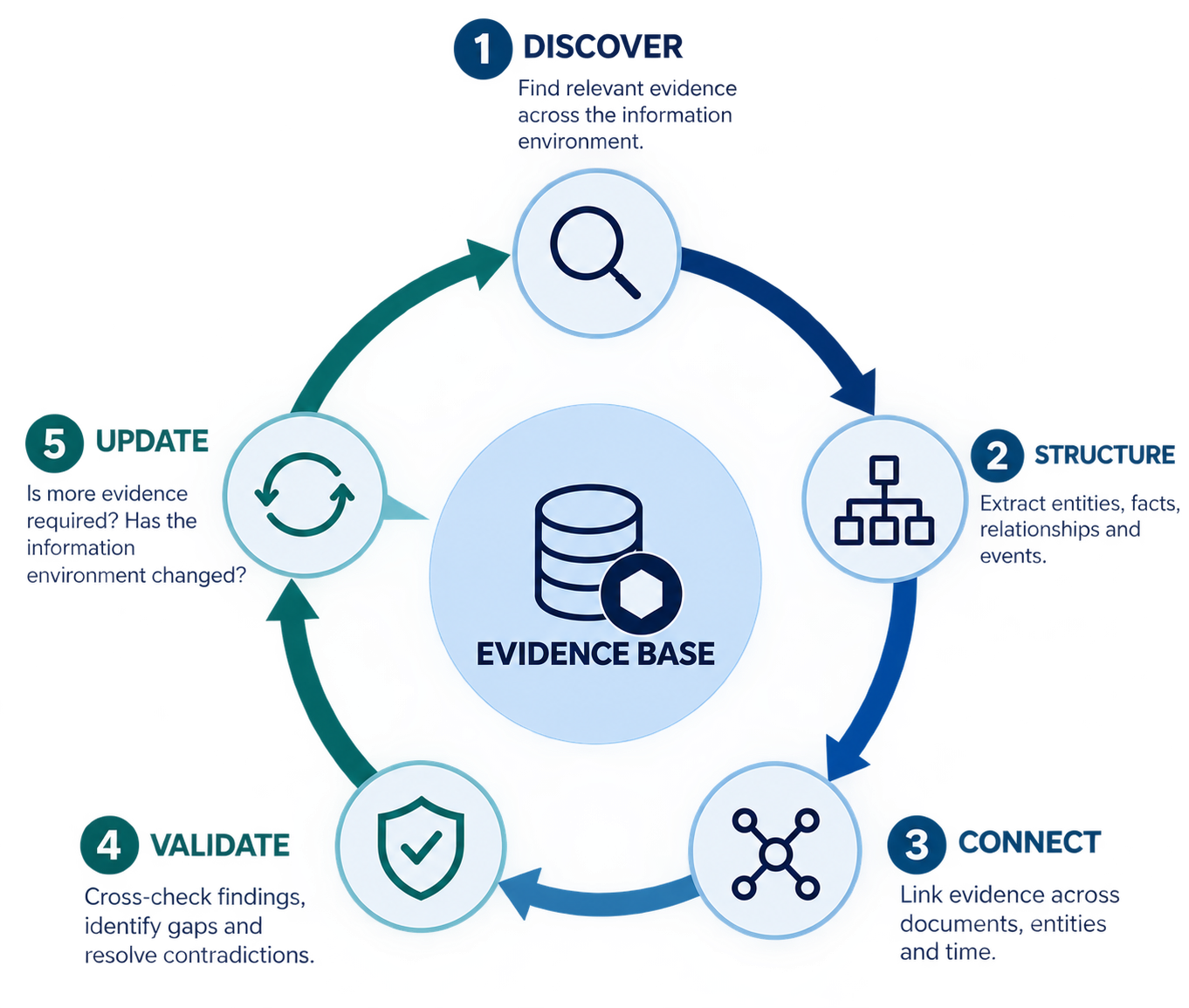
01 — Discover
Find the evidence that matters.
Glass.AI continuously discovers information across the business web, identifying companies, organisations, people, products, activities and other relevant entities.
Research begins by defining what is being investigated, such as entities, attributes, activities, geographies and time periods. The system then expands the search, discovers relevant entities and sources, and traverses the web to uncover evidence that conventional search can miss.
Discovery is iterative rather than one-shot.
Each finding can lead to another source, entity or signal. Validation can also reveal gaps or unresolved questions, feeding new requirements back into discovery. The research therefore progressively widens and deepens rather than stopping after an initial set of results.
02 — Structure
Turn unstructured information into usable evidence.
Finding a document is only the beginning. Glass.AI uses language understanding and semantic analysis to identify the entities, claims, activities, attributes, dates and relationships contained within web content.
Its dynamic topic and entity models allow the system to understand not just what words appear on a page, but what the content says about the businesses and activities being researched. The result is structured evidence rather than a collection of documents.
03 — Connect
Understand the relationships between evidence.
Business evidence rarely exists in isolation. A company announcement may connect to an investment. An investment may connect to a new facility. A partnership may reveal a new capability or supply-chain relationship.
Glass.AI connects evidence across documents, sources and entities to build a richer picture of what is happening. This creates a connected body of evidence in which individual findings can be investigated through the sources and relationships behind them.
04 — Validate
Test evidence before relying on it.
Not every source is equally authoritative, current or reliable. Glass.AI evaluates evidence across dimensions including accuracy, authority, freshness, corroboration, provenance and relevance.
Where possible, information is corroborated across independent sources and matched against authoritative sources such as official registers and regulatory information.
Validation can also reveal gaps, contradictions, uncertainty or areas where more evidence is needed. The objective isn't simply to find an answer. It is to establish how well the evidence supports it and what remains unresolved.
05 — Update
Keep the evidence current, and keep researching.
Research doesn't end when an answer is produced. As evidence is validated, Glass.AI can identify gaps, contradictions, outdated information or areas where the available evidence is insufficient. These findings can become new research requirements, triggering another iteration of discovery.
At the same time, the business web continues to change. New companies emerge, products launch, investments are announced, partnerships form and regulations change.
Glass.AI therefore continuously monitors both the evidence it has already discovered and the gaps that remain. New information can update existing evidence, resolve uncertainty or trigger further discovery, creating a continuous cycle of discovering, validating and updating the evidence base.
The result is not a static answer, but an evidence state that can become progressively more complete, current and reliable.
Built for evidence at web scale
Transparent AI is not a single model or technique. It is an architecture for evidence-led research.
It combines large-scale web discovery, resource-efficient language understanding, semantic analysis, entity intelligence, dynamic ontologies, provenance and validation into an iterative research system.
Large-scale discovery
Glass.AI continuously reads the business web, discovering companies, organisations, people, products, activities and other relevant entities across millions of sources.
Specialised AI architecture
Glass.AI's architecture combines specialised models, algorithms and techniques, applying the most appropriate approach to each task to deliver capability, accuracy and efficiency at scale.
Language understanding
Our AI understands business language in context, identifying the entities, activities, events, attributes and relationships described across web content. This allows it to distinguish what a source actually says from the words it uses, and turn unstructured information into structured evidence.
Dynamic ontologies
Glass.AI uses dynamic ontologies to structure complex and evolving subjects, connecting entities, topics, activities and relationships. They can adapt as new companies, technologies, activities and themes emerge.
Intelligent crawling
Glass.AI follows the evidence. Crawling is directed towards pages, documents and linked sources that are likely to add useful information to the research.
Provenance
Evidence remains connected to its source throughout the research process, allowing individual data points and relationships to be traced back to the underlying evidence.
Validation and corroboration
Evidence is assessed against multiple sources and signals, helping identify supporting evidence, contradictions, gaps and uncertainty.
Want to learn more about Glass.AI technology:
Evidence-led research
The goal isn't simply to generate an answer. It is to build the evidence that makes the answer trustworthy.
Glass.AI takes an evidence-first approach to AI and business research. It discovers evidence across the business web, structures and connects what it finds, validates the evidence and identifies what remains unresolved. New evidence can then update existing findings or trigger further research.
The result is research that is not just generated, but grounded, traceable and continually refined.
Glass.AI’s Transparent AI provides a trusted evidence layer for AI systems and business research, giving every answer a foundation that can be investigated, challenged and updated.
Want insights no one else can see?
Discover how Transparent AI can transform your research process and unlock intelligence hidden across the web. Let's discuss your specific needs.