
Glass.AI Launches Monthly AI Adoption Tracker. Evidence From the Business Web.
We are excited to announce the launch of our Global AI Adoption Tracker, a free monthly email digest that shows how organisations are adopting AI across sectors and geographies. Each edition will span 13 sectors of the economy, with concrete examples of applications, use cases and links to the evidence behind them.
Why this monthly report exists
There is a growing body of research about AI Adoption, with varying methods to answer all sorts of questions. Whilst there is no shortage of these studies, the reports often rely on surveys and self-reported estimates rather than detailed and verifiable records of how organisations are being transformed by AI.
For example, McKinsey’s The State of AI runs a large-scale survey of AI use and impact with business leaders. Governments and academic researchers have taken their own approach too: the UK’s Department for Science, Innovation, and Technology (DSIT) commissioned survey-based research by Technopolis and IFF Research on UK business AI adoption, whilst Stanford’s Digital Economy Lab runs its own survey-based AI Adoption Monitor. Broader statistical bodies such as the US Bureau of Labor Statistics publish data that demonstrates AI’s impact on workers.
Frontier AI labs and the Big Tech companies have also been reporting on usage through their own data:
Anthropic’s The Economic Index analyses patterns of Claude usage.
Google’s AI and Economy ATLAS analyses interactions on the Gemini app, AI Mode, and Gemini API.
OpenAI’s State of Enterprise AI evaluates both a worker survey and customer usage data.
Microsoft’s Global AI Diffusion examines individual generative AI usage.
These studies are very valuable, with surveys capturing respondents' experiences, and product data tracking the respective platform-specific usage. However, we are missing an evidence-based record of AI adoption that explains what organisations are actually doing, with specific use cases and case studies.
Our tracker aims to add another perspective, going directly to the source to extract specific examples of AI adoption.
How the tracker works
Our Transparent AI conducts deep research across a multitude of web sources, including company websites, case studies, news, and other public sources. This allows us to identify the company, its technology, the business function, and the nature of the reported use. Each entry links back to its source to allow readers to inspect the source of the evidence.
The tracker notably spans a full range of applications, AI technologies and sectors. It includes small and medium-sized organisations alongside large technology firms, and is not limited to Generative AI, also reporting on uses of computer vision, machine learning, and robotics.
Tracking all these examples via a monthly newsletter should add new evidence of how AI is adopted over time.
The first edition
The first edition is live on our website and can be found here.
It tracks 13 sectors:
Consumer Goods and Services, Energy and Environment, Financial Services, Government, Healthcare and Scientific, Industrial and Agriculture, Leisure and Hospitality, Media and Arts, Non-Profit and Education, Professional Services, Real Estate and Construction, Supply Chain and Transport, and Technology.
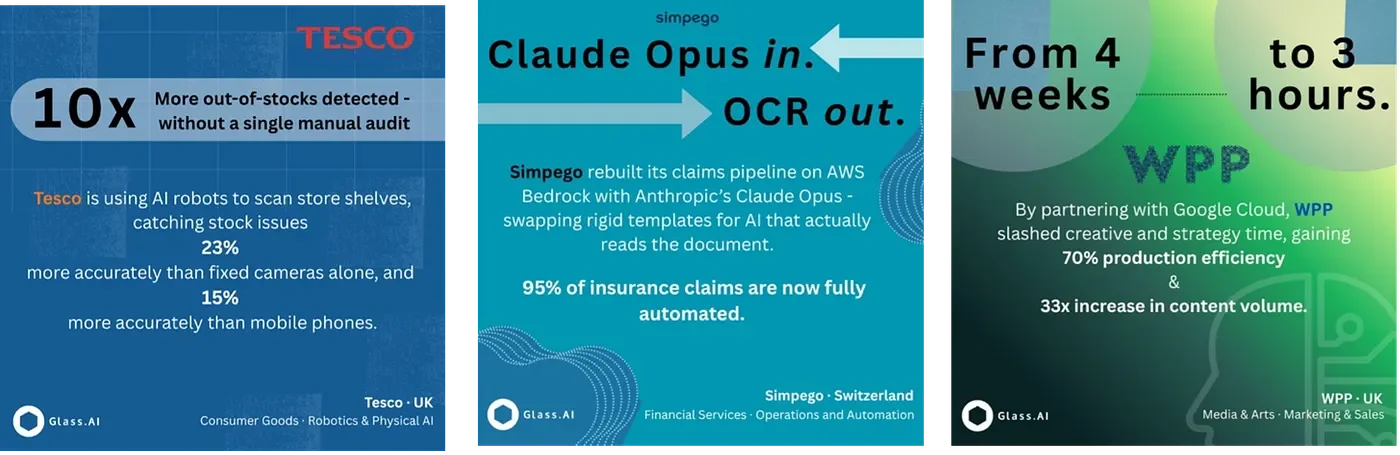
Each month, the adoption tracker will surface the top AI adoption examples across these sectors. These three examples below show the variety of applications that are reported on:
Tesco, using AI robots to detect stock issues more accurately.
Simpego, rebuilding its insurance claims process around Claude Opus.
WPP, reducing a four-week creative and strategy process to three hours.
A closer look
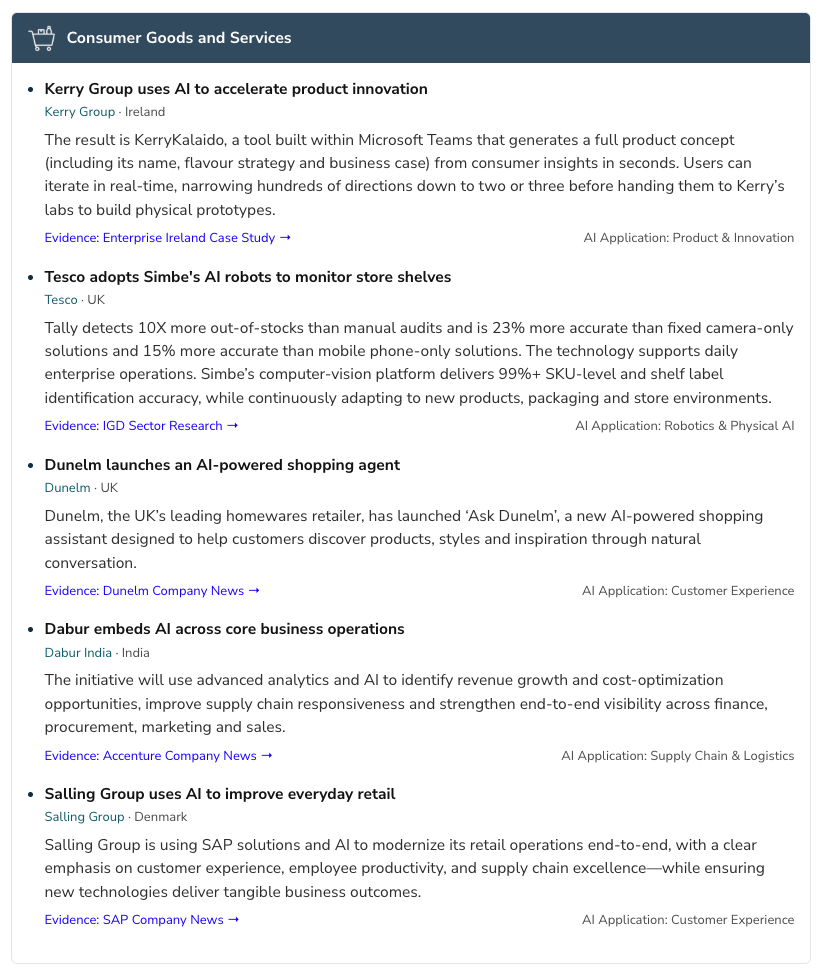
To give a sense of the detail the tracker provides, the sector preview below from this month’s report covers a range of adoption, from product development and customer experience to retail operations and supply chains:
What we’re seeing
Compiling evidence across sectors, applications, and geographies allows patterns and trends to be drawn out. Across this month’s report, a few stood out:
AI is moving beyond experimental pilots into everyday operations. Trialled tools are becoming standard parts of daily workflows, from shelf-monitoring robots in retail stores to AI systems automating document processing for staff.
AI is becoming embedded in products and customer experiences. Rather than remaining behind the scenes, customers are increasingly interacting directly with AI, whether via AI-powered shopping assistants using natural language to find products, or through self-checkout systems that are flagging issues in real time.
AI agents are reshaping how teams work. Organisations are deploying AI agents that handle specific and high-effort work independently. They are task-directed towards classification and coding, or even as internal assistants supporting specialist legal, research, and advisory teams.
Physical AI is becoming increasingly visible. AI is moving more into physical spaces, with humanoid robots entering industrial trial environments, and computer-vision systems embedding into factory floors and store aisles.
AI is being applied directly to research and scientific work. AI-powered clinical decision support tools are being trusted by millions of healthcare professionals, and autonomous laboratories are using AI to guide real-time data collection. AI is increasingly shaping the pace of scientific discovery.
Why is this AI adoption tracker useful?
Individual announcements can be missed. Our monthly digest provides more comprehensive coverage of which tasks are being tackled with AI in different sectors, where new tools are entering everyday operations, and how businesses describe the impact. It provides examples that researchers, policymakers, analysts, economists and business leaders can examine in context. In summary, we aim to contribute a useful, regularly updated view of what companies are actually doing with AI.
Want to stay informed about how AI adoption is evolving? Sign up here to receive our free monthly reports directly to your inbox.