
Finding Europe’s Hidden Advanced Materials Infrastructure for the European Commission.
Europe has a substantial network of research and technology infrastructure supporting the development of Advanced Materials. But knowing that this infrastructure exists is not the same as being able to find it, understand what it does, or determine whether a particular facility can support a specific industrial application.
That was one of the challenges behind a major European Commission study into the Research and Technology Infrastructure (RI&TI) landscape for Advanced Materials.
The study ultimately identified 2,943 Advanced Materials RI&TIs across the EU, covering laboratories, research centres, pilot lines, innovation platforms, testbeds, cleanrooms and demonstrators. Technology Infrastructures accounted for around 36% of the identified facilities.
But the significance of the exercise is not just the number of infrastructures identified. It shows what becomes possible when AI-driven research discovers and structures information fragmented across the open web.
The infrastructure was there; finding it was the problem
Research and Technology Infrastructures are critical to moving Advanced Materials from scientific discovery towards industrial deployment. They enable development, testing, prototyping, validation, and scale-up across a wide range of technologies and materials.
Yet the European infrastructure landscape is highly fragmented. Existing inventories are often maintained by individual organisations, universities, national programmes or specific initiatives. The report found that many existing mappings are project-based and can become outdated when funding ends. Search and filtering capabilities also vary considerably, while relatively few platforms provide comprehensive, multi-criteria views of Advanced Materials capabilities.
For someone looking for a facility to solve a particular technical problem, this creates a difficult research task. The relevant information might sit on a university website. It might be buried several levels deep within a research centre’s pages. It might be described using terminology that differs between countries or institutions. And information about the infrastructure itself may be spread across pages describing equipment, research programmes, materials, applications and services.
Reading the web as an evidence source
For this study, Glass.AI large-scale language understanding technology was used to help address that discovery problem through evidence-led deep research across the web.
Glass.AI developed an AI-based model to identify organisations providing Research and Technology Infrastructures in Advanced Materials. The model used a taxonomy of Research and Technology Infrastructures and Advanced Materials, refined and translated for different countries.
Rather than relying solely on existing directories, the approach analysed the public web at scale. It read information from millions of organisation websites and other sources, including university websites, government sources, and commercial research entities.
The taxonomy included different material categories and functionalities, allowing the research to move beyond identifying an organisation to understanding the capabilities associated with its infrastructure.
This distinction is important. Finding an entity is only the beginning of research. Understanding the attributes that make that entity relevant is where the real value lies.
From hidden facilities to a European landscape
The resulting analysis produced a much broader picture of the European Advanced Materials infrastructure landscape.
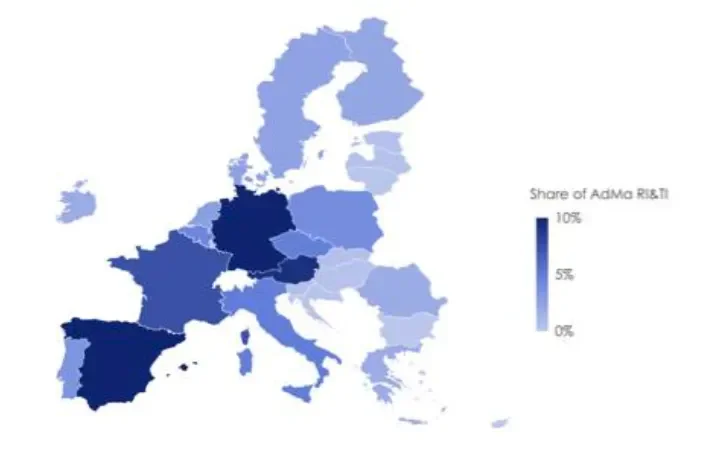
The 2,943 identified RI&TIs were concentrated particularly in Western and Southern Europe, with Germany, France, Spain and Austria accounting for a substantial share of the infrastructure landscape. At the regional level, concentrations were visible around major industrial and research ecosystems including Oberbayern, Stuttgart, Karlsruhe, Darmstadt and Dresden in Germany; Île-de-France and Rhône-Alpes in France; the Basque Country and Catalonia in Spain; and several regions of Austria.
The data also made it possible to examine what these infrastructures actually support.
Electronics accounted for 42% of sectoral applications, followed by energy at 30% and mobility at 13%. Medical devices accounted for 10% and construction 4%. Across horizontal activities, materials characterisation and Advanced Materials manufacturing were particularly prominent.
That turns a list of facilities into something much more useful: a structured view of an ecosystem. This enables potential users to be connected to appropriate infrastructure capabilities.
Why depth matters
One of the most interesting aspects of this work is that the challenge was not primarily a lack of data. There was an enormous amount of data. The problem was that the evidence was distributed, inconsistent and expressed in different ways.
A research centre might describe itself in terms of a scientific discipline. A university might describe the same facility through its equipment. A technology centre might emphasise industrial services. A national inventory might use a completely different classification.
The study therefore developed a taxonomy covering Research and Technology Infrastructure types, Advanced Materials categories and material functionalities. The taxonomy was adapted to national terminology and used to guide the web crawl and evidence capture.
For a landscape such as Advanced Materials infrastructure, that means continuing beyond the obvious organisations and sources to discover the less visible facilities and the attributes that distinguish them. This deep research needs to establish what exists, what it does, how different pieces of evidence relate to one another, and whether the available evidence is sufficient to support the classification.
From discovery to policy evidence
The value of the mapping extends beyond creating a directory. The report identifies infrastructure mapping as an important instrument for improving visibility, accessibility and strategic coordination. Comprehensive mappings can support scientific collaboration, industrial uptake, evidence-based policy planning and impact monitoring, while also helping identify capability gaps and inform funding priorities.
The study also found significant gaps in the current landscape. Limited availability and visibility of pilot-scale and pre-commercial production facilities can make it difficult to move beyond laboratory experimentation. Digital, AI and computational capabilities are unevenly distributed, while specialised testing, certification and sustainability capabilities also vary across Europe. The report highlights the need for stronger coordination between infrastructures and better connections with industrial ecosystems.
These are difficult questions to answer without first having a sufficiently comprehensive view of what exists. Better policy analysis depends on better evidence about the underlying landscape.
What this demonstrates about AI research
The Advanced Materials study is a useful example of where AI can contribute to research in a way that goes beyond generating answers.
The evidence-led web research was one component of a wider evidence-gathering methodology with our partners that also included desk research, a survey with 144 responses, 108 interviews, patent and company analysis, international benchmarking, case studies and stakeholder validation.
The role of AI was to extend the reach of the research: to systematically explore a web landscape that would be difficult to map comprehensively through manual research alone, and to structure the evidence into a form that could then be analysed alongside other sources. That is particularly valuable when researching deep or hidden attributes.
The question is often not:
“Which organisations work in Advanced Materials?”
It is:
“Which organisations have a particular facility, capability or service, where is it located, which materials and applications does it support, and who could potentially use it?”
Those answers rarely exist in a single database or are easy to surface. They have to be built from evidence distributed across the web.
From the web to an evidence base
The European Advanced Materials study shows what is possible when the web is treated not simply as a place to search, but as a large and continually changing evidence source.
Glass.AI’s contribution was to help turn that fragmented evidence into structured information about organisations, infrastructures, capabilities, applications and locations. This enabled the wider study to analyse the European landscape at a scale that would be difficult to achieve through conventional research alone.
For complex sectors, the most valuable information is often not the information that is easiest to find. It is the information hidden across thousands of organisations, pages, terminology and sources.
Evidence-led deep research means finding it, understanding it and connecting it until the landscape starts to become visible.
It was a pleasure to collaborate with Technopolis Group, Fraunhofer Institute for Systems and Innovation Research ISI, European Future Innovation System (EFIS) Centre, TECNALIA Research & Innovation, Danish Technological Institute and Tekniker.
You can read the full report here.
If you have a problem that would benefit from an evidence-led deep research approach, then get in touch.