
Glass.AI Partners with the Office for Life Sciences and Technopolis to Map and Monitor the UK Life Sciences Sector.
Mapping complex, fast-evolving technology sectors is one of the toughest challenges in economic policymaking. Traditional statistical methods often rely on rigid industry classifications and manual data collection, making it difficult to capture cutting-edge innovation, early-stage startups, or diverse companies operating across multidisciplinary value chains.
To overcome these barriers, the UK Office for Life Sciences (OLS) commissioned a consortium comprising Glass.AI and Technopolis for a three-year assignment to transform how official data is collected for the annual Bioscience and Health Technology Sector Statistics (BaHTSS) publication.
By combining Glass.AI’s evidence-led (deep web) research with domain expertise from Technopolis and OLS, the project established a repeatable methodology that now underpins these UK Official Statistics. The approach moved OLS from a largely subjective, manual collection process to an automated, auditable and scalable framework, saving time and resources while significantly enhancing data quality and sector coverage.
Looking beyond traditional industry codes
The life sciences sector is central to the UK’s national economic policy and Industrial Strategy. According to the latest 2024/25 BaHTSS publication, it generates £125.8bn in turnover and employs 306,700 people across the country. Produced for more than 15 years, the BaHTSS dataset tracks commercially oriented businesses across Biosciences and Health Technologies, including drug discovery, health analytics, medical devices and surgical technologies, as well as newer fields such as genomics. As the sector has grown in strategic importance, the dataset has become a key research asset.
However, traditional methods, including those that use Standard Industrial Classification (SIC) codes, struggle to keep pace with the dynamics of modern sectors:
Static Categorisation: SIC codes fail to capture multidisciplinary technology convergence or diversified firms offering specialised life sciences products.
Administrative Lags: Official registries often miss fast-growing startups, large, diversified companies, and emerging sub-sectors, due to reporting limitations and publication time lags.
Resource Intensity: Previous manual collection required extensive resources to gather, review, and validate data, creating operational bottlenecks.
Rather than asking, “Which industry code has this company been assigned?”, Glass.AI’s technology deep-reads the public web to examine what companies actually do in real time. This capability was a key reason for the commission and supported OLS’s objective of further improving the quality and consistency of BaHTSS.
Combining deep-Web AI with expert domain knowledge
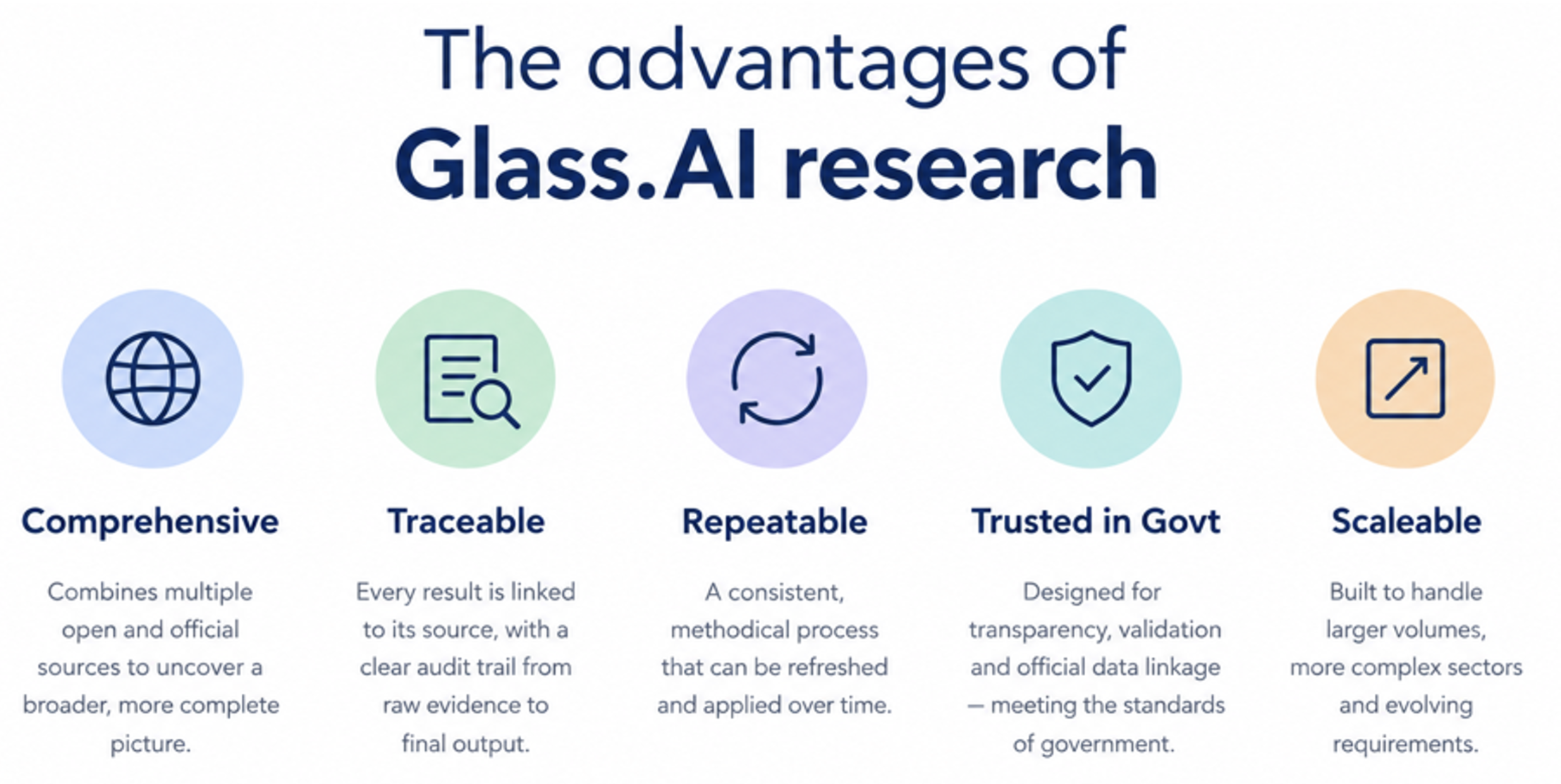
In response, the consortium developed a new, technology-led workflow. It combines Glass.AI’s Transparent AI and automated web discovery with expert human-in-the-loop validation and official administrative registers to establish a new standard for collecting official statistics:
Deep-Web Discovery & Extraction (Glass.AI): Combines Glass.AI’s core dataset with prior publications, directories, and partner data to build an extended, web-crawlable taxonomy that leverages millions of corporate pages.
Ensemble AI & NLP Classification (Glass.AI): Applies an ensemble of linguistic, semantic, and statistical models to evaluate company text and generate independent probability scores, via a precision-recall framework.
Expert Human-in-the-Loop Review (Technopolis & OLS): Sector specialists audit sample boundaries and edge cases, refining scoping rules, eliminating false positives, and continuously retraining the AI models.
Official Data Linkage & Validation (OLS): Matches entities via Company Registration Numbers (CRN) to the ONS Inter-Departmental Business Register (IDBR) to integrate official turnover, headcount, and legal status metrics.
Key impact & results
Beginning with the 2023/24 publication and expanding in the 2024/25 edition, the use of open-web AI research in official national statistics has provided a new and more comprehensive view of the UK life sciences ecosystem:
7,600 Legal Entities Classified: Successfully mapped and categorised 6,500 active life sciences businesses operating across 7,600 legal entities.
Granular Ecosystem Insights: Provided OLS with detailed visibility into regional clusters, geographical hotspots, and emerging health tech niches.
Evidence-Based Policy: Established a shared, trusted evidence base supporting cross-government decision-making and Industrial Strategy planning.
Cost Savings: Reduced manual research overhead while increasing data transparency, quality, and coverage.
A repeatable template for Industrial Strategy priorities
A single point-in-time snapshot shows the shape and characteristics of a sector today; successive, comparable iterations reveal how a market evolves. This approach represents a step change in how high-quality data can be gathered at scale and tracked over time. By establishing an auditable annual baseline, Glass.AI has demonstrated that web-derived intelligence can integrate seamlessly with the human insight required for official statistical publications. Moreover, this work provides a proven, adaptable template for mapping other critical UK Industrial Strategy sectors and emerging technology domains.
For information, see the latest BaHTSS publication here.